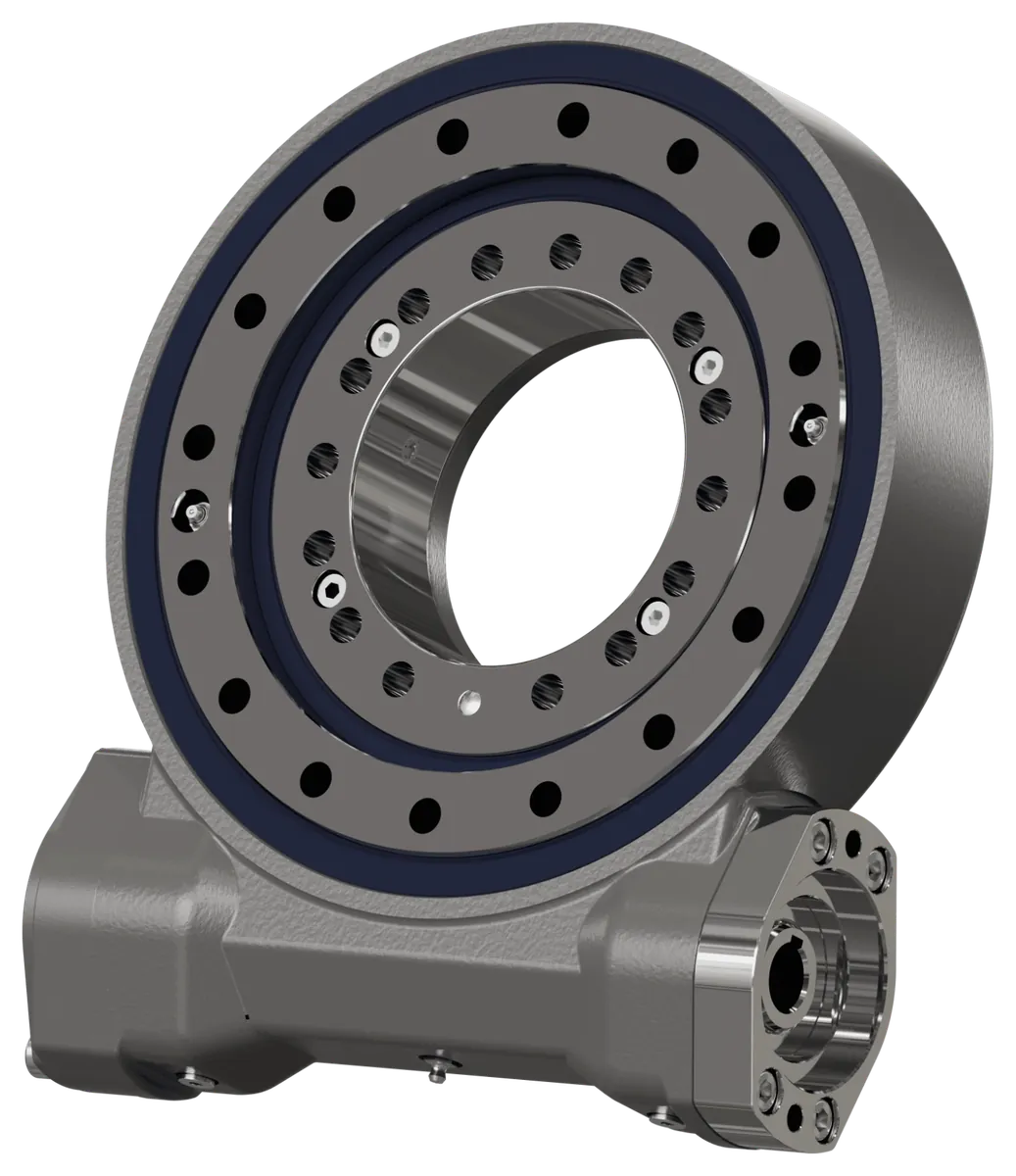
Which one fits?
- Torque
- 1 kN·m
- Moment
- 5 kN·m
- Ratio
- 55:1
- Weight
- 20 kg
The smallest here: the one to choose when its ratings cover your loads with a safe margin.
Typical uses: solar trackers, antennas and satellite dishes, camera and sensor positioners, small rotary tables.
Where it leads
-
Lightest. 20 kg, 156 kg less than TD-R25: for mobile machines and wherever weight counts.
-
Most compact. 160 mm outer Ø, 550 mm less than TD-R25: fits where space is tight.
- Torque
- 3.4 kN·m
- Moment
- 13.5 kN·m
- Ratio
- 45:1
- Weight
- 31 kg
Against TD-R5: +240% torque, +170% tilting moment, +38 mm bore, +11 kg.
Typical uses: solar trackers, antennas and satellite dishes, camera and sensor positioners, small rotary tables.
Where it leads
-
Fastest turning. 45:1: the most output speed from the same motor, for quicker moves.
- Torque
- 6.3 kN·m
- Moment
- 35.6 kN·m
- Ratio
- 62:1
Against TD-R7: +85% torque, +164% tilting moment, +47 mm bore.
Typical uses: solar trackers, aerial work platforms, small cranes, welding positioners and robot arms.
Why pick it
-
The step between TD-R7 and TD-R14. Pick it when TD-R7 falls short on torque but TD-R14 would be more than you need: it gives +85% over TD-R7, and TD-R14 another +37%.
- Torque
- 8.6 kN·m
- Moment
- 71.2 kN·m
- Ratio
- 96:1
- Weight
- 62 kg
Against TD-R9: +37% torque, +100% tilting moment, +120 mm bore.
Typical uses: solar trackers, aerial work platforms, small cranes, welding positioners and robot arms.
Why pick it
-
The step between TD-R9 and TD-R17. Pick it when TD-R9 falls short on torque but TD-R17 would be more than you need: it gives +37% over TD-R9, and TD-R17 another +71% for +21 kg.
- Torque
- 14.7 kN·m
- Moment
- 143 kN·m
- Ratio
- 104:1
- Weight
- 83 kg
Against TD-R14: +71% torque, +101% tilting moment, +70 mm bore, +21 kg.
Typical uses: truck-mounted and utility cranes, aerial platforms, digger derricks, large solar trackers.
Where it leads
-
Highest gear ratio. 104:1: finer positioning and more torque from a smaller motor, at a slower output speed.
- Torque
- 18.5 kN·m
- Moment
- 210 kN·m
- Ratio
- 94:1
- Weight
- 116 kg
Against TD-R17: +26% torque, +47% tilting moment, +45 mm bore, +33 kg.
Typical uses: truck-mounted and utility cranes, aerial platforms, digger derricks, large solar trackers.
Where it leads
-
Least backlash. 0.1° of play: the most precise positioning, for trackers, antennas and cameras.
-
Most capacity per kilo. 1.8 kN·m of tilting moment per kg, the best ratio here.
- Torque
- 27 kN·m
- Moment
- 310 kN·m
- Ratio
- 104:1
- Weight
- 176 kg
Against TD-R19: +46% torque, +48% tilting moment, +145 mm bore, +60 kg.
Typical uses: heavy cranes and lifting equipment, drilling rigs, wind turbine yaw and pitch systems, large positioners.
Where it leads
-
Most output torque. 27 kN·m nominal, 27× TD-R5: turns heavier and off-centre loads, and keeps going against the wind.
-
Highest load capacity. 2360 kN axial and 310 kN·m tilting moment, 62× the moment of TD-R5: the one for heavy loads and long booms or arms.
-
Strongest hold when stopped. Holds up to 158.3 kN·m at rest: keeps the load in position against wind or an overhanging weight.
-
Least backlash. 0.1° of play: the most precise positioning, for trackers, antennas and cameras.
Guidance drawn from the catalogue ratings. Our engineers will confirm the right size for your loads and duty cycle.
All specifications